
| Appellations | |
| Opulent Oakville | |
| By Andy Demsky
|
|
|
|
Just beyond a cluster of smooth ancient hills on the northern edge of Yountville lies one of America’s premier grape growing and wine producing areas. Here the valley floor broadens and a leafy sea of vineyards stretches away on both sides of the Napa River. This is Oakville. Some of the most talked about wineries in the country are located in this appellation cradled between the Vaca and Mayacamas Mountains. While Oakville has been a wine
producing region since the1860s, it came to prominence in the mid
1960s when Joseph Heitz began using Cabernet Sauvignon fruit from
the now-famous Martha’s Vineyard. The following year Robert
Mondavi, approaching retirement age, broke away from Charles Krug
to start his own winery. Mondavi later joined forces with the Rothschild family of France
to start a bold experiment that became Opus One, today located just
north of the town of Oakville on Hwy 29. In more recent years the appellation has reached new heights in the world of über-premium wines with the emergence of boutique wineries such as Screaming Eagle, Silver Oak Cellars, Dalla Valle, Harlan Estate and others that command sky’s-the-limit prices for their wines. The real difference, though, between the wines of Oakville and
those from neighboring appellations can be quite subtle, even for
the experts. He goes on to explain that in terms of grape cultivation, the appellation is divided into three distinct groups, each offering the vines markedly different growing conditions.
“On the eastern side you find volcanic soils, red soil with
iron in it. Where the valley meets the western slopes the soils
are more alluvial. And in the center are soils related to the river,
heavier clay with a higher water table,” he says, noting that
each change in soil produces variations in flavor and crop yields.
Among Oakville’s numerous wine tasting opportunities, none
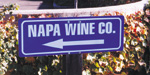
is so broad ranging as what you’ll find at Napa Wine Company,
located in the actual town of Oakville. As a custom crush and winemaking
facility, some of the top wines in Napa Valley are produced here
and are available in the tasting room. The list rotates daily and
is a who’s-who of names such as Pahlmeyer, Madrigal, Oakford
Cellars, Staglin Family Vineyard and numerous others including Napa
Wine Company’s own outstanding Cabernet Sauvignon, Sauvignon
Blanc and Pinot Blanc. |
|
|
|
|
|
|
|
|
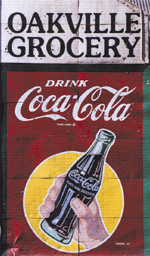
Across the road is Oakville Grocery, a gourmet grocery store and
a nibbler’s paradise. The moment you walk through the door
samples of olive oil and mustard, pear and pumpkin butter await.
On the tightly packed shelves picnickers and serious shoppers find
fresh produce, spices from around the world and a mouthwatering
array of olives, meats and cheeses. The deli serves up everything
from dolmas, gourmet pizza and pasta salad to Beluga caviar. This store, listed on the National Register of Historic Places,
has exported Napa Valley charm throughout Northern California and
today you’ll find Oakville Grocery stores in Healdsburg, Palo
Alto, Walnut Creek and Los Gatos. Check their web site for seasonal
events: www.oakvillegrocery.com.
To the south, on Hwy 29, Mustards Grill is where Oakville goes
for hearty roadhouse-inspired fare. When chef Cindy Pawlcyn opened
the place almost 20 years ago, she set a new standard for Napa Valley
fine dining — casual atmosphere, fresh, seasonal ingredients
seasoned with herbs from the garden out back. Step inside and breathe
deep. The oak wood smoker and wood-burning grill fill the restaurant
with aromas of baby back ribs, smoked quail, pork chops and other
meaty temptations. Entrees range $14 to $26. Don’t miss the
onion rings. On the southern-most edge of the appellation, Brix Restaurant offers
artfully designed seasonal Wine Country cuisine with names such
as Spicy Ahi Tuna-Asparagus Tempura “Futomaki” Roll &
Garden Sprout Salad. Dinner entrees run from the mid $20s to the
mid $30s. Enjoy wines from throughout the valley either by visiting
their wine shop or selecting from the wine list. If you want to
concentrate on Oakville wines expect to find a price range from
$26 for a 1998 Cakebread Chardonnay to $550 for a Dalla Valle “Maya”
Napa Valley proprietary red. For more information on the Oakville Appellation, visit www.oakvillewinegrowers.org.
|
| Oakville Grade | |
 |
Oakville Grade could be called this appellation’s Bible Belt.
The two-lane road running west off Hwy 29 is home to two charming
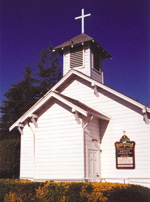
places of worship. The first, St. Stephen’s, is a white, steepled,
one-room church where for nearly a century local worshippers have
gathered for Sunday services, funerals, weddings and other events.
Cut out of a small piece of the To Kalon vineyard, services have
been held here since 1904. The current structure was built in about
1914 for an interdenominational congregation to sing the praises
of traditional Christian beliefs. Baptisms used to be held in the
Napa River. Today, traditional Episcopal services are offered weekly
by Father Michael Bowhay. A short distance west, the Carmelite Monastery rests at the base of the Mayacamas Mountains. Hidden among stands of huge pine, redwood and oak dripping with Spanish Moss, the sprawling structure was once the Doak Mansion, completed in 1921. The many-windowed brick edifice nearly became the summer White House for Calvin Coolidge in 1927. Today this is a House of Prayer offered as a spiritual retreat for those who wish to engage in the life of prayer practiced by the five priests and one brother who live here full-time. The grounds are home to deer, wild turkeys and a blue heron that steals goldfish from the pond in back. Those who visit here find the monastery saturated in timeless solitude. |