
 |
|
|
The 18th Amendment
Comes to the Napa Valley |
|
| Excerpted from 'Roots of the Present: Napa Valley 1900 to 1950' | |
| By Lin Weber | |
 |
On November 29, 1918, President
Wilson signed into effect a law upholding the emergency anti-alcohol
measures he had approved back in the spring. This apparent endorsement
of Prohibition paved the way for further, ever more restrictive
legislation. On January 16, 1919, Congress passed Texas Senator
Sheppard's "bone dry" constitutional amendment to outlaw
liquor in America. The alcoholic beverage industry would thus go
belly up at 12:01 AM, January 17, 1920. Its authors called it "the
greatest piece of moral legislation in the history of the world." Passage of the 18th Amendment was simply the legislative act that
provided the machinery for implementing it. On December 21, 1922, the Wright Act went into effect, a California
law that mandated sheriffs, constables, DAs and other peace officers
to enforce the Volstead Act [the legislation that provided for the
enforcement]. Whether they wanted to or not, they now had to pursue
an aggressive course against bootlegging. Napa Police Chief Otterson,
who liked alcohol and disliked taking orders from anyone, quit.
It was weeks before the city was able to find a replacement. The sheriff, Berryessa's tee-totaling Joe Harris, stayed on and,
with a few deputies, got to work orchestrating raids of Napa County's
thriving liquor industry . . . The Napa Valley was home to many
small, illegal wineries during Prohibition, but there were also
many stills that mass-produced brandy and booze. Mrs. E.F. Evits
was "not a bit perturbed" when Harris came upon her little
hootch factory at the Oat Hill mine. She ran two stills, a 25 gallon
one and a 10-gallon. One of the targets of an August 1923 bust was
a major facility concealed in the bushes off Ink Grade Road in Angwin.
D. Samuels of Pope Valley and Harold Stevens of Vallejo ran six
stills there with inventory and equipment worth many thousands of
dollars. They built the plant next to a stream, which not only gave
them an excellent source of water to use in brewing, but also provided
an excellent thoroughfare for moving the booze. Following the creek
bed, runners could travel up and down the mountain without leaving
a telltale trail in the brush. Covering 800 square miles of largely rural, and often largely inaccessible
terrain, enforcement efforts were for the most part concentrated
in the more populated parts of the Valley, where all segments of
the citizenry proved to be quite active in their new role as "criminals." Most of the people snagged in Sheriff Harris' dragnets were men,
but there were female bootleggers as well, like Mrs. Evits. Mrs.
Gianna Brovelli had to pay $200 for selling liquor. A 13-year-old
girl was taken into custody in Calistoga along with A. Acquistapace
and five other men, who were transporting a load of booze. Over
in Sonoma County, Emma Fetters of Fetters Hot Springs was among
a dozen arrested in a bust at the US Bar on Fourth Street. There
was a scuffle as one of the apprehended men tried to wrest a gun
from a detective. The shock of the experience may have overwhelmed
Mrs. Fetters, because she died less than two weeks later. Other women reacted with considerably more resolve, however, and
some became local legends for a time, as Prohibition continued. The granddaddy of all Napa Valley raids occurred in September 1925
in Napa Junction at a place known to locals as "Dago Mary's,"
a speakeasy run by the Negri family. It was a carefully planned
drama … A cluster of police cars crept into Napa Junction in
the dead of night, and the officers prepared their assault. They
split into two teams. Simultaneously, one team burst into the place
through the front door while the other came in the back. The first
team found a smoke-filled room packed with people, among them some
of the Valley's leading citizens. The officers who came through
the back, however, encountered Mary in the kitchen. Enraged at their
invasion of her enterprise, Mary threw silverware, glassware, plates,
pots and pans, small appliances and everything else she could get
her hands on at the lawmen before she could be subdued. The raid captured 35 people, including three women. Dave Cavagnaro
was among those arrested. He was fined $900 and may have paid the
fines of several others, as well. Special police officer Uvoldi
(a Prohibition agent) was also caught in the net and dismissed from
his position. Immediately afterward, Harris went to Chiles Valley
and arrested his own brother, Harry Harris, who also bootlegged. After Sheriff Harris declined to run for another term, the Prohibition
wars in the Napa Valley cooled considerably. This proved to be a
perfect time for the grapegrowers of the county to expand their
horizons and further line their pockets. Napa Valley vineyardists supplied bootleggers with the ingredients.
The harvest's far-flung recipients squeezed grapes into juice and
the juice fermented. As a result, grape growers actually profited
from Prohibition. Since it was legal for heads of household to make
wine for consumption by their own families, wine was the preferred
beverage for many who wanted to enjoy an alcoholic drink while staying
within the bounds of the law. The demand for grape juice was strong,
and prices rose sharply. Unfortunately, the best wine varietals
were too thin-skinned to ship well. Growers had to graft on or replant
with grapes that could go long distances in refrigerated freight
cars. Georges de Latour introduced Californians to the Alicante grape,
which stood up much better to traveling, although it made a very
rough wine. Mission grapes also experienced a comeback, because
they, too, shipped well, but the wine from the little black berries
tasted no better than it had 50 years earlier. In 1923 Alicante
and Petite Bouschet went for an astounding $85 a ton, because of
the toughness of their skins. The more fragile Cabernet, Pinot Noir,
Zinfandel, Grenache and Malvoisie sold for $55 per ton. The following
year prices for everything went up an additional $5. Nearly 1400 railroad cars left the Valley in 1923 loaded with grapes,
a jump of about 40% over the previous year. The 1927 crush was the
largest Napa Valley had ever experienced. That year vineyardists
filled 3,500 railroad cars with the fruit of their harvest. Prices
were a little lower … but the yield was enormous. After a good deal of experimentation, Beringer Brothers developed
yet another way to make wine. Using a dehydrator that they built
on their property, they turned grapes into raisins and formed the
raisins into bricks. The recipe for producing wine from bricks was
quite simple: One brick plus one gallon of water plus one pound
of sugar plus about one week would, under warm conditions, produce
wine.
Skirting the regulations regarding sacramental wine was especially
popular. Catholics, Episcopalians and Jews consumed most of the
altar wine in America. In New York, which had large numbers of all
three faiths, sacramental wine was rationed according to the number
of members registered in each church and synagogue. Head counts
in the pews were greatly exaggerated, and in some cases entirely
fabricated. A 600-member New York City synagogue turned out to be
a laundry. A delicatessen and an East Side tenement building tried
to pass themselves off as places of worship, and the "Assembly
of Hebrew Orthodox Rabbis of America" consisted of an Irishman
named Sullivan. Episcopalian parishes enjoyed phenomenal growth.
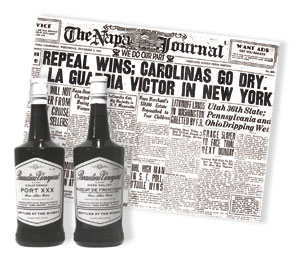
Prohibition was finally repealed, of course, an event that was celebrated with no more enthusiasm than in the Napa Valley. Unlike on the East Coast, where vast fortunes were made during this social experiment, Prohibition was simply an interruption. Yes, it had financial consequences, almost all detrimental, and a great deal of time and money was lost, but in the end the Napa Valley continued on as a farming community, and a percentage of those acres were devoted to grapes, most of which was made into wine, and the natural cycle continued, as it does today. |