

 |
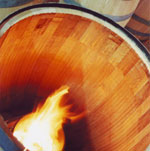
Ever wonder why we drink "a toast" to our tablemates when raising our glasses of wine? Though the term may refer more specifically to celebrating a significant individual or event, proper homage is due as well to the quality of the "toasting" of the oak barrels in which the wine was aged. |
| A Proper Tribute to the Mighty Oak Barrel |
|
| By Laurie Davis | |
 |
All oak wine barrels are literally
toasted over an open fire to a certain degree to deliver an enhanced
depth and richness to the wine. It is often expressed as the mouth-watering
essence of such flavors as "vanilla, butterscotch, caramel,
chocolate, coffee" and even "fresh-baked bread" or
"hazelnut." Winemakers make very precise decisions about
which kind of oak wood they want in their barrels and the degree
of toasting needed to achieve a calculated effect on the taste of
the wine. The oak barrel can play almost as important a role in
the wine-drinking experience as the grapes themselves. Why oak? No other tree can impart the kinds of complementary flavors
during fermentation that oak yields. And not just any oak will do.
Only oak that can be grown straight and tall, with as few branches
as possible, make the grade, since the grain must be tight enough
to prevent leaking. They must also be grown slowly, since faster
growth induces larger tree rings that reduce the grain quality.
Oak trees used for making premium wine barrels can be 90 to150 years
old, and the forest management of these oak trees is in itself a
highly specialized art. There is already a great deal of complexity in creating wine, since
one must consider the grape variety, the soil and climate in which
it is grown, the age of the vines, the particular blending of a
variety of grape juices and the length of time the wine will be
fermented. Now add to that the intricacies of barrels made of oak
from different regions with varying soils and climate, toasted to
different "depths" (categorized as "light" to
"heavy") to bring out the most unique elements of the
wine and you have virtually limitless possibilities for the final
product. The Napa Valley is home to four barrel making facilities, called
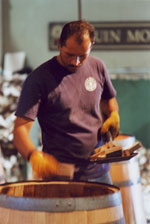
cooperages. One of these, Seguin Moreau, opens its doors to the
public to view barrel-making in action. Three Master Coopers, one
of whom is a fourth generation practitioner, oversee a busy workshop
in Napa that produces 130 to 150 barrels per day. You can visit Seguin Moreau from Monday through Friday, with several
tours available from morning to early afternoon. The tours are self-guided,
with placards and signage to help you understand the process. You'll
be treated first to a 10-minute video, but then be sure to take
advantage of the free earplugs they make available, because this
is a real working facility with nearly non-stop hammering. Despite the noise, it is an experience that is delicious to the senses. Your view from the raised gallery allows you to see all phases of barrel making, a fascinating blend of ancient craft and modern technology. The exotic aromas of slow-toasting oak, which waft between sweet and spicy to earthy and pungent, smell almost good enough to eat. You'll remember these intoxicating scents as you savor the fine wines of the Napa Valley. Hours: Monday through Friday, with
tours at 9:00AM, 11:30AM and 1:30PM. Advance reservations requested.
Call (707) 252-3408. Directions: The facility is a 10-minute drive from downtown Napa. Drive south on Soscol about 4 miles then turn left on Hwy 29. After 1/2 mile you will see Seguin Moreau on your left, but continue about another 1/2 mile, and turn left at the light (across from Airport Road). Get in the left lane and turn left at the light onto Kelly Road. Make the second left at Camino Dorado, and turn right into the parking lot at 151 Camino Dorado. |