|
|
| Napa Valley: The Land,the Wine, the
People |
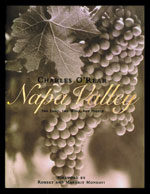 |
By Charles O'Rear
Wineviews Publishing/Ten Speed Press ($40.00)I am not sure you
could spend forty dollars on anything else and get such a part of
the Napa Valley to take home and enjoy. Heresy that it might be,
we would even suggest that you substitute this marvelous book of
Chuck O'Rear photographs (and Janice Fuhrman essays) for a bottle
of Cabernet in your carry-on bag, if you have to choose between
the two. They even have two things in common: both are products
of Napa Wine Country, and both get better with age. This is a book
that you will enjoy and appreciate more the longer you look at it,
the more times you turn a page.
O'Rear, for a quarter of a century a National Geographic photographer
who has settled in St. Helena and turned his lenses to the countryside
he now calls home, has produced a beautiful collection of photographs
that go so far beyond the traditional "wine book" as to
be a new category altogether. Yes, he has photographs of the Mondavi
Winery on Route 29. He could hardly not, in that Robert and Margrit
Mondavi wrote the forward, but the point is that he also has portraits
of 62 growers you may never have heard of, and who shape the book
with every bit as much vibrancy as the images of the famous people
and places that also appear throughout the 232 pages.
As a photographer, O'Rear has been given extraordinary access to
the hidden corners of the Valley, as well as to some of its most
prominent edifices and most closely-guarded secrets.
Writer Janice Fuhrman, a Napa neighbor of O'Rear who has been called,
and rightly so, an essayist, contributes the words that accompany
the images.
"Janice's words brought to the book in words the feeling that
I try to capture in my photographs," O'Rear said. "She
has lived in the Valley only a few years, but she has quickly grasped
the meaning of this place in a way that few journalists have."
"There are wineries here with museum-quality art collections,
wineries that are themselves art pieces because of their striking
architecture: Spanish mission, French château, Victorian,
Tuscan, farmhouse, barn-style, and post-modern," she writes.
"They come with innovative gardens and long views across acres
of lush, emerald valley and hillside. Most important of all, behind
each winery, gallery, or eatery there are the people - vintners,
scientists, farmers, chefs, writers, and painters, all of whom will
take the time to tell you the stories of how they came to fall in
love with wine and with this valley."
In the end, it is O'Rear's understanding of the people, not just
his technical mastery and artist's eye, that makes this book a definitive
piece on the Napa Valley.
|
| It Happened in Northern
California |
| |
By Erin H. Turner
Twodot Books (Falcon) ($8.95)Wonder what the Bear Flag Revolt
was all about, who Snowshoe Thompson was and what part Agoston Haraszthy
played in the early days of the wine trade? Pick up a copy of this
slim volume and find out. These and many other short vignettes about
the Golden State make for an interesting literary diversion. The
bonus is you'll be able to tell your friends a whole long list of
things they didn't even know they needed to know. For nine dollars
it's a steal.
|
| The New Sotheby's Wine
Encyclopedia |
| |
By Tom Stevenson
A Dorling Kindersley Book ($50)
Even if this edition misses a few things (the Yountville AVA, for
instance) it should still be in every serious (or fledgling) wine
enthusiast's library. Beautiful to look at, brilliantly designed,
easy to use and 600 pages long, it is such a fascinating book that
it's worth spending time with even if your usual libation is a glass
of the House Red. For about the price of a very nice bottle of Cabernet,
it's a sound investment. If you want a more manageable guide that
is easier to travel with, the same publisher has just released Good
Wine Guide 2002 by Robert Joseph, a bargain at $12.95. Or better
yet get both and be prepared both at home and in the field.
|
| Roots of the Present -
Napa Valley 1900 to 1950 |
| |
By Lin Weber
Wine Ventures Publishing (St. Helena - $24.95)
The long-awaited sequel to Ms. Weber's history of the earlier years
of the Napa Valley, this volume is even more delightful than the
former. Replete with facts (the longest bar in the West), personalities
(all the winemaker names you know, plus a lot you have never heard
of), social history, personal and political skullduggery, tragedy
and triumph, it is written for anyone with a love of, or at least
a curiosity about, the Napa Valley.
|
| Wine and War |
| |
By Don and Petie Kladstrup
Broadway Books ($24.00)
This is a necessary book for people who crave the history of wine.
It's tough going at times, more reporting than story telling, but
nonetheless it is a fascinating book. The anecdotes and facts scattered
throughout, and the cast of characters on every page, make it a
volume worthy of a spot on the reference shelf of every oenophile.
|
| The Curiosities of Food |
| |
By Peter Lund Simmons
Ten Speed Press ($16.95)
First published in London in 1859, this is a book only the British
could produce. There are instructions on cooking locusts, and, for
that matter, just about anything else you can think of. And we do
mean anything. Mixed in are anecdotes ("Grasshoppers tried
and found to be good eating") so dry as to resemble dust. A
perfect gift for the self-styled gourmet always looking for a new
recipe.
|
| French Lessons |
| |
By Peter Mayle
Knopf ($24)
As long as people compare the Wine Country of California to the
vineyards and vineyard towns and villages of France, you might as
well read up on what is happening on the far side of the Atlantic.
And there is nowhere finer to do it than in Peter Mayle's latest
offering. Go along with him as he visits wine and food festivals
throughout France. But to really enjoy this handsome and enjoyable
volume find a restaurant with a nice deck or patio, order a glass
of Napa Pinot Noir and an appetizer or two, and read away. You'll
have created your own feast for the senses, without the jet lag.
|
| Four Wings and A Prayer |
| |
By Sue Halpern
Pantheon Books ($23.00)
This book is about butterflies. Butterflies as passion for those
who study them, as politics to the regulators, developers and conservationists
who variously protect and threaten them, and as an integral part
of human nature. Author Sue Halpern does an admirable job of combining
all the parts of the puzzle in a book that celebrates butterflies,
but does it in a way that is as fascinating for each part of the
story as much as it is for the whole. The fact that the Monarch
Butterfly is one of the most exquisite creatures in all of nature
is almost an added bonus in this delightful and finely crafted work.
|
|