

| Can You Speak cooperage? | |
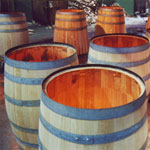 |
Do you know your stiles from your staves, your chime from your
chamfer, your bilge from your crozer? Here are a few cooperage terms
that will have you speaking like a barrel-making professional: Bung Plug The piece, traditionally
made of wood, now commonly silicone, that goes in the bunghole of
the barrel. Bilge The center of the barrel where
it has the largest diameter. Chamfer The sloping ends of the staves.
Chime The end of the stave at the
point of the barrel's smallest diameter; the part of the stave into
which the groove and chamfer are cut. Cooper A skilled craftsperson who
has learned the trade of barrel making through an apprenticeship
or formal cooperage program. Cooperage The production facility
where the barrels are made. The French term is tonnellerie. Croze The groove at the end of the
stave or barrel cut to accommodate the head. Esquive Smaller bunghole on the barrelhead
used for racking wine, typically located either at the 6 o'clock
or 8 o'clock position. Flagging Dried rush or river reed
used in the fabrication of barrelheads. Heads The flat ends of a barrel or
vat. The pieces of wood forming the heads are called headpieces
or head staves. Hoops The strips of metal or chestnut
wood that hold the barrel together. Galvanized steel is the most
common material used, and the ends of each strip are riveted together.
The French term is cercles. Hoop Driver The tool used, together
with a hammer, to force down the hoops to make the barrel tight.
This also applies to a hydraulic machine that performs the same
operation. Shaving Hand or mechanical removal
of 1 to 3mm of the internal surface of a used barrel to remove wine
deposits and expose a fresh wood surface. Spiles Small wooden conical-shaped
pegs used to seal holes and stop leaks. Staves The pieces of wood used for the sides of a barrel (in which
case they are bent) or a tank. The term is used for the rough-cut
material before it is processed, as well as the finished product.
The French term is douelle. Toasting Also called "charring." The effect of continually heating the inside of the barrel over an open fire, after it is bent. It usually causes browning or blackening of the inside surface of the staves. |