
|
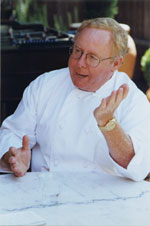
The Interveiw: Philippe Jeanty |
|||||||
|
|||||||
 |
Your bistro's food is inspired from your
childhood in - Champagne. Yes. I was lucky that my family was involved in the
old ways as far as food. I had aunts and uncles that used to raise
rabbits and chickens and pigs, lamb. Here you raise animals for
the romance of it. There we raised them out of necessity. I had a lot of aunts and uncles and some of them lived out in the
country. My grandmother had 12 kids. So that was a lot of aunts,
uncles and cousins. There was one particular aunt and uncle that
had a farm. And we shared everything from the farm with the family.
The day, for example, we would kill a pig was a big event. A lot
of the family would come by. One of the things we made was blood
sausage. My job when we killed the pig was to pump the blood. You
would knock them out, slash their throat and you would hang them
so the blood would flow and you'd pump the front leg. [He makes
an up and down pump-handle motion.] I wonder if you'd ask your own kids to do
that. [Laughs] I would hope they would get a chance to experience something
like that. One of the more romantic, I guess, things we would do
when I was about seven and eight years old, we used to go to a farm
around the corner, about five o'clock at night to get the milk at
the barn. And we would carry it in a metal container and we'd get
the milk basically straight out from the cow. And I would carry
the milk and in the winter it's freezing in Champagne so it was
nice to carry that warm milk. And then we would have to take it
and boil it. Because it was not pasteurized. And you'd let it sit
and the cream would rise to the top. And you knew the whole process
of milk. Now everything comes so packaged and so pasteurized and
clean. We had a big garden also. My aunt used to grow a lot of leeks because
in Champagne it's cold and leeks are one of the things that grow
well there. It's a slow growing season and I remember in the winter
she used to pull the leeks out and turn them upside down and put
them in the snow so that they'd keep longer. The snow would keep
them from freezing, but yet they would stay cold enough to keep
for a couple of months. They had a lot of apple trees and we'd pick
the apples. And you'd walk in the attic and it would be so fragrant
of apples. A lot of your earliest memories are about
food. The good thing is that it's related to what we do [at Bistro Jeanty].
A lot of what I draw from is memory, from taste, sight and smell.
And also emotion, feeling. Which is really what describes bistro
food. It's almost like soul food. It's very satisfying. You know,
it comes from the soul. And I think that's one of the things that
makes the Bistro successful. You started working in a kitchen quite early.
In the kitchen at Moet et Chandon, right? Fourteen. Yes. I always liked food, even as a kid. My father worked
at Moet, though he was not in the food part of it. And one summer
he asked me, 'You're so in love with food, do you want to try to
work in the kitchen?' And I said sure why not. So he talked to the
proprietor of the dining room at Moet et Chandon and they decided
to let me work there. It was a private dining room where Frederic
Chandon and VIP guests would eat. And I liked working with Joseph
Thuet, the chef. I felt comfortable in the kitchen from the beginning,
so I started an apprenticeship. I'm guessing it wasn't the kind of hectic
kitchen you find in a restaurant. Right. It was much more quiet. And the great thing is what they
did was very classical. It was a good strong basis for me to learn.
After three years there I went to work outside Paris at a couple
of restaurants and then in 1977, when they were opening Domaine
Chandon here in Yountville, Joseph Thuet called me and asked, 'Do
you want to go to California?' And at first I told him no. But two or three weeks later, I received in the mail a round-trip
ticket to San Francisco, with a note from him saying, 'You're going
to go there, you have a round-trip ticket, if you don't like it
come back.' When I showed up here at 20 or 21 it was a big move. From there, when we opened the restaurant at Domaine Chandon we
were so busy. We worked seven days a week, 16 hours a day for a
long, long time. And when the executive chef at the time - I was
sous chef - left after a year, I took over. I was 22 by then. Napa Valley was much different then. Could
you get good cheese? Fresh fish? No. It was very difficult. Even salmon was difficult to get fresh.
Very difficult. I remember having to make deals with fishermen not
to freeze what they were getting and buy it right off of them. Produce,
there was a little bit of produce. The Trefethens had an extensive
garden and they helped us with the herbs. There [were] a lot of foods that Americans didn't like. If you
would've done blood sausage or pigs' feet at the time, a large body
of your clients would say, "This is not for me." There was a long ways to go in their knowledge of food and French
food. Real French food. Now it's a whole different ball game. Here
we do lamb tongue, we do steak tartar. People love that stuff. It was always my goal to do the real thing. And it took 20 years
to get there, where people didn't get scared of those items. I think for me the most rewarding part of the Bistro here is that
I'm really doing food that I love. Food that tastes the way that
it should taste. Not adapted. There's an interesting balance happening
here in the Valley. We've got people coming for wine; we've got
people coming for food. But people don't really have to come here
for the wine. They can get the wine. They do have to come here for
the food. Do you think that balance has shifted to the food direction?
Or do you think it's well matched? I think it's become - and I may be speaking politically …
[laughs] I think it has become a natural balance. I certainly think
that the experience here at Bistro Jeanty wouldn't be complete without
wine. If someone was here drinking coffee with their dinner I would
think, 'what's the point?' It's a natural balance that happened
and that's why the Napa Valley is so popular because you can have
awesome wine with awesome food. I hear you're opening, or re-opening Jack's,
the restaurant in San Francisco. What do you envision doing there? I've always wanted to have a place in San Francisco. I've always
believed that if I could make it in San Francisco, it's a big food
city, it would really be awesome. Very satisfying. So when I saw
that building come on the market, which is the oldest running restaurant
in San Francisco, Jack's has been there since 1864. It's a registered
landmark. It's a beautiful building and it's such a part of San
Francisco history. I get people who talk to me or send me letters
about Jack's saying, 'My husband proposed to me at Jack's,' and
'Our first date was at Jack's,' and it kind of ties into some of
the things I want to do. I feel like I'm going to be able to bring
Jack's back and give it back to San Francisco. I'm planning on doing
a French brasserie. Similar to here, but maybe a step up from it.
A little more sophisticated but still fun. If everything goes well, I'm hoping to open by October but my designers
say, "You're crazy." This is one of those Barbara Walters questions.
Looking back, what would you change about your career? I'm a firm believer that things happen for a reason. Some people
will ask me, "Don't you wish you would have opened [the Bistro]
ten years ago?" And I don't know if I was ready then. I look
at everything in life that's good or bad as being a lesson. So would
I change anything? No, probably not. Having two daughters now, I
have a better understanding about life and what life is about. Is that reflected in the bistro? I think so. I try to remind my staff of what is important. And to me what's important is to treat people right. Especially when customers come in the door. Treat them well, treat them with kindness. Don't have an attitude, which is often, unfortunately, what you get at a restaurant - you get an attitude at the door. What's the point? |
||||||