

 |
|
| Winemaker Mia Klein | |
| By Susan Reynolds | |
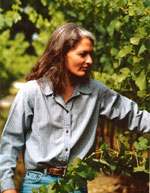 |
Mia Klein has created a rather
unique niche in the wine industry: she is one of a handful of women
winemaking consultants who have developed their own brand of wine.
During the course of her career, Mia has had a unique opportunity
to learn every aspect of winemaking. She began her career after
developing an interest in the pairing of food and wine. After a
brief stint as a cook and a longer period of time working in a retail
wine store in Southern California, she decided to study winemaking
at U. C. Davis. In 1983 she became assistant winemaker at Chappellet
Vineyards, working closely with famed winemaker Cathy Corison. After five years at Chappellet, Mia moved on to Robert Pepi Winery
where she met Tony Soter, a highly respected winemaking consultant.
In 1990 she began working with Soter as a consultant. "I love
consulting," Mia explained. "It's always stimulating work
because each estate has its own variables and uniqueness."
Mia works closely with each winery's viticulturist, winemakers,
and other consultants in what she calls "the art of making
wine." "You can get tunnel vision if you only work with one vineyard,"
Mia said. "Each appellation has a myriad of diverse elements,
so it's important to keep separating out what particular variables
you want to call into play when making the wine." As a winemaking
consultant, Mia is present from the planting of vineyards through
every stage of the wine growing and winemaking process. While she
serves as winemaker for the 4,000 case Dalla Valle Winery, she works
closely with an on-site winemaker at Fisher's 10,000 case winery.
Bressler Vineyards is another client. "I function as a generalist,
which means I do everything from selecting grapes to racking bottles."
Although each vineyard has unique qualities, Mia said her clients
frequently seek consistency in the final product. "Each vintage
has its unique variables, but if we can control a host of factors
(what vines are planted, how many grapes we leave on the vine or
how many we thin, how the grapes are picked and crushed, what happens
in the fermentation process, what barrels we use, how it's aged,
how it's racked and the blending process) we can usually produce
a wine that consumers can identify as coming from a certain vineyard." In the last ten years Mia has seen a trend among female consultants
such as Cathy Corison, Zelma Long and Maryann Groff to launch their
own brands. "After we've been around for a while, we find ourselves
wanting the artistic license that comes with developing your own
brand. If you work for someone else, they tend to put you in a slot,
which may not be maximizing your talents. Even though it can feel
chaotic when you take on your own brand, it's a good chaos, because
it leads to creative freedom." Mia began selling her own brand, Selene, in 1991, focusing at the
time on Sauvignon Blanc and Merlot, mostly because they didn't conflict
with her clients, who were primarily Cabernet-based. She initially
produced a thousand cases; she is up to 4,000 cases today. "I've
gone through a lot of growth … that wasn't very easy,"
she reported. "Selene has given me complete license to create
a product that reflects my well-rounded knowledge and it has actually
increased my skills as a consultant because I have now experienced
everything that goes into producing and marketing a quality wine
first-hand." Mia also noted that marketing her own brand led to increased trust
on the part of her clients. "Because I've been required to
make some difficult decisions in developing my own brand, most of
which have been successful, my clients have greater trust in my
ability to make good decisions for them. It's helped me become more
assertive. If you want to develop a superior wine, you can't be
a 'yes man' in this industry." Her passion for wine actually began with an interest in food. "It's
a natural marriage because the flavor and texture of food is very
primal, as it is for wine. What we are really seeking is a good
marriage between wine and food. If you think about it, every aspect
of this business is about relationships. In every phase of development,
I am forging relationships with the clients, the viticulturists,
the cellar crews, the winemakers, the marketing staff. The biggest
part of my job as a consultant is to bring everyone together with
a shared vision. We want everyone involved to be invested in the
final product. You want everyone to have an artistic passion for
the wine." Mia also noted that actual relationship counseling can be part
of her expertise. "Sometimes I am called in to sort out relationships
so that the winery can maintain continuity. I occasionally serve
as a sounding board for two sides so that I can facilitate or enhance
relationships. Although most family wineries presume their children
will take over the family business, sometimes the child wants to
pursue something else. It can cause real friction, so having me
hold an objective vision while they sort it all out can be very
helpful. Personally, I usually recommend that the heirs work in
another field, or at the very least in retail (to learn marketing)
so that they can determine whether they have a sincere interest
in making good wine. You have to have a real passion for wine to
succeed in this business." Mia, who lives with her husband (a local veterinarian) and their
two dogs, a cat, and a rabbit, drives a sporty Honda F4I motorcycle
and studies Aikido, an ancient Japanese practice that combines the
drawing of wooden Japanese weapons with karate-like movements. "The weapons, primarily wooden swords with live blades, stem
from the Feudal Era in Japan. My husband's mother is Japanese, which
probably drew me to it, but once I started taking lessons, I was
hooked." In the course of the last half dozen years she has
earned a Black Belt in the art, something she says has benefited
her in every aspect of her life. "Aikido involves philosophical training as much as it does
physical training. It is a way of harmonizing two energies coming
together, and I have definitely found it beneficial in my consulting
work. My favorite saying from Aikido is that 'form is emptiness
and emptiness is form.' I have found that this philosophy helps
me find and hold my space in all situations, and that's definitely
a plus in the winery business." Contributing Editor Susan Reynolds is a freelance writer and photographer who has lived and worked in the Napa Valley for 14 years. She was the Founding Editor of "Woman to Woman", and her work has been published in a variety of national and regional magazines. |