

| A Short History of Bocce | |
| By CL Waverly | |
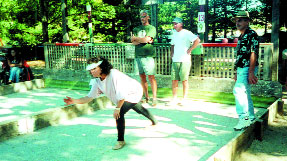 |
|
|
The sport of bocce (or bocci,
depending upon whom you ask) is so deceptively simple to observe
that it goes without saying that beneath it all is a more complex
sport than you might first imagine. It would have to be, for a sport
that started 7,000 years ago in Egypt, was played in Greece 300
years before the birth of Christ, and was popular in the Italian
Swiss Alps two millenniums ago to still be popular. You may not
know why the Punic Wars were fought - almost no one does, and even
fewer people care - but you can know that Roman soldiers played
bocce while they were between battles. Of course you don't need to know the history of bocce to enjoy
it. You may already know that the British version is called "bowls"
and the French version was once called "Petanque." Lawn
bowling descends from it, and the rules from game to game remain
remarkably consistent. A special court is not required. A flat lawn the right size will
do nicely, but a regulation court is best and the Napa Valley has
some very respectable ones. The backstops are placed 60 feet apart,
and are 12 feet wide with four foot-long sides. The foul line is
marked ten feet from the backstop. The surface of the court can
be packed dirt, clay, grass, stone dust or any number of artificial
surfaces. Two different sizes of bocce balls are used in a game. The target
ball, called the "pallina" (or "pallino"), is
the smaller of the two and is usually a light color, to contrast
with the larger balls. The team balls, the "bocce's",
are color-coded, a different color for each team, four balls per
team. Teams can be made up of one to four players, with multiple players
going in rotation. The first player throws the pallina into the
opposite court (the opposite end), then rolls the first bocce. The
object is to get your bocce as close to the pallina as possible,
without knocking the smaller ball out of play. Each successive player
tries to get his or her bocce "inside" the other team's
ball, to get it closer to the pallina. One point is awarded for
each bocce a team has "inside" the other team's bocces.
For official play, one and two-member teams play to 12 points, four
player teams play to 16, but in casual games scoring can go to 21,
and include a rule that a team must be ahead by two points to win
the match. You can be sure that strategy enters into all of this. There is
"spocking" ("bombing"), when you intentionally
knock an opponent's ball away from the pallina. There is the sacrifice
and the bank shot, the raised bowl, the underarm throw and the bowled
delivery. There are points, fouls and measurements to argue, sometimes
heatedly, sometimes repeatedly, but what would bocce be without
a good argument? In the Napa Valley, indeed, in most regions and countries where
bocce is played, a glass or two of wine is important, too. Not as
important as the game perhaps, at least not for the moment, but
important all the same. It also gives players one more point of
contention to discuss if the game doesn't provide enough. To watch some of the Valley's finest bocce players in action, and enjoy some music, a film, wine and Italian barbecue, come to La Famiglia Winery in Oakville on Saturday, July 14 6 pm (tickets are $30.) If you are interested in playing in the tournament, call Julie Abate at (707) 968-2346. |
|