

| Cool Caneros: | |
| Napa Valley's Off-Road Gem | |
| By Andy Demsky | |
 |
|
|
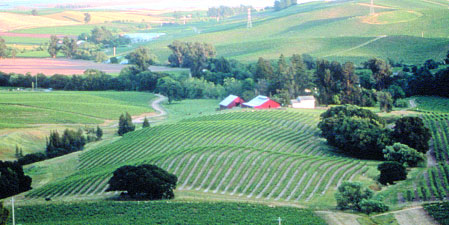
Many of this year's five million visitors to Napa Valley will miss one of the region's most vibrant and complex viticultural regions. And more ironic is that most of those visitors will drive right through this unheralded area on Highway 121-12 without ever knowing it. It's called Carneros. "We're just being discovered as a destination," says Nan Campbell, executive director of Carneros Quality Alliance, a group of vintners and grape growers who promote the region. "A lot of people miss us as they drive through on their way to other places." The Alliance has produced a new "wine country field guide" to this appellation that could finally lift some of the anonymity of this area. "It's a double-edged sword," says Campbell of the potential of increased numbers of wine lovers. "You can still ride your bikes on the road here. Our idea of a four-star restaurant is Babe's Burgers and Franks. We'd love to see more visitors, but we would also like Carneros to remain an off-the-beaten-track gem." According to the guide, Napa Valley doesn't begin somewhere north of the town of Napa. It is born in the wetlands that border San Pablo Bay. The land that emerges out of these marshes is the Carneros region, where soils are a blend of clay and ancient seabed. Here along the rim of the bay the days are cool and nights are even cooler and a constant marine breeze ruffles the leaves and grasses. Some of the biggest names in the Napa Valley wine industry own vineyard land here: Robert Mondavi Winery, Clos du Val, Mumm, Domaine Chandon, Sterling Vineyards, Cuvaison and Beaulieu Vineyards. The cool, steady temperatures of the Bay, combined with the distinct terroir of the soils, create a perfect environment for Pinot Noir and Chardonnay, the grape varieties most associated with Carneros. A long and moderate growing season allows the grapes to mature slowly and evenly, letting winemakers wait for just the right moment when sugar and acid achieve balance. Thanks to this slow maturation, Carneros grapes are fully ripe at lower sugar levels and higher acids, achieving great depth of flavor extract. "Unlike France, the end of our season is not usually determined by rain," says Michael Terrien, winemaker at Acacia Winery. "We have the great luxury here to ripen the fruit well." Carneros is one of the oldest grapegrowing regions on the West Coast. Wine grapes were first planted here in 1830 and the first winery was established in 1870. Its early viticultural fortunes fell first with the spread of the root louse phylloxera in the late 1800s and then with the onset of Prohibition in 1918. By the 1970s, however, it was back on the winemaking map. Even though the area includes numerous recognized wineries such as Saintsbury, Artesa Winery, and Bouchaine Vineyard, it still receives far less attention from wine country visitors than neighboring wineries to the north. "It's a world that loves cabernet," says Terrien of the millions who drive through Carneros on the way to Napa and Sonoma. Terrien believes that the trend pendulum will eventually swing back toward Pinot Noir's favor and that cool Carneros may be the focus of some white hot attention. "I don't mind that pinot noir is like a little brother though. I kind of like that." "I really like the community down here," says Terrien. "There's a lot of helping each other out with equipment, with manpower and with ideas. I really like the generosity of Pinot Noir makers." The character of the area is rural and retains much of the wild, remote spirit once common throughout this part of California. It's two-lane farm roads with few stop signs and fewer stop lights, and little streams winding through stands of old oaks. Step out of your car and you can hear the soft noise of the wind rustling across the landscape. The Carneros Quality Alliance's guide ($14.95) comes complete with colorful maps, climate and soil information and a complete guide to the cluster of wineries here. It is a feast for the eyes as well, offering stunning photos of the region throughout the seasons. The pages are filled with pastoral glimpses of waterfowl, cows, hay fields, vineyards and even muddy sloughs. It's also a treasure trove of information about the land, its seasons and cycles and the complex web of life. The guide's author, Eileen Campbell, is a respected science writer who has worked with the Monterey Bay Aquarium and is currently employed by the San Francisco Zoo, producing educational development materials. "We wanted someone who was a blank slate in terms of wine country," says Nan Campbell. As a result the guide is written cleanly and beautifully, avoiding many of the cliches that tend to crop up in wine writing. "We're so much more than farming grapes and making wine," says Campbell. "We're an incredible ecosystem. We're right on the Pacific flyway so the area is home to migratory birds." The Carneros field guide is available at most Carneros wineries on the Carneros Alliance web site, so point your browser to www.carneros.com. |
|